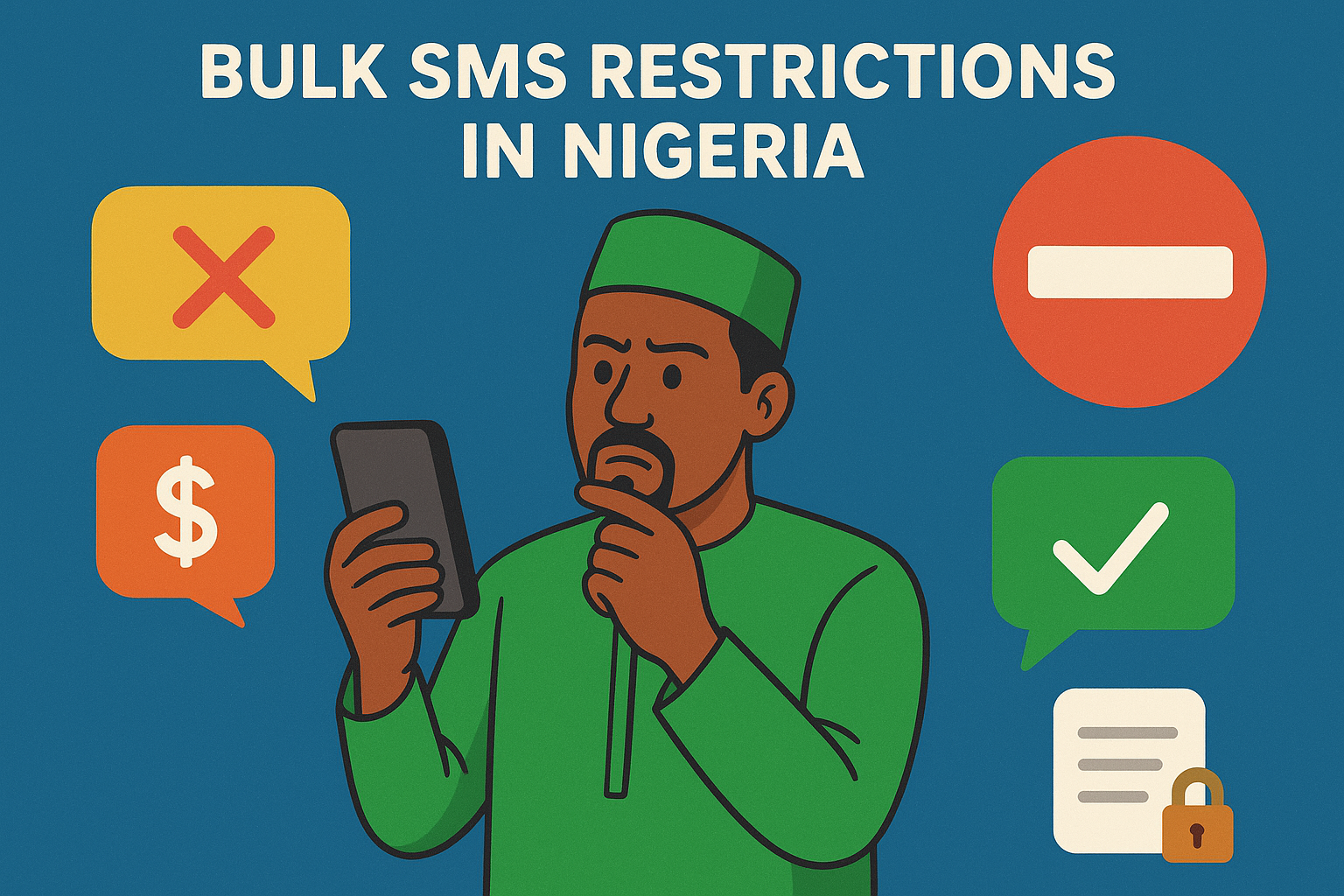
If you have been using bulk SMS in Nigeria for some time, you would have noticed one frustrating reality—many messages don’t deliver. Even when you use a standard platform, there are too many restrictions on what you can write and how you can arrange your content. For example, you cannot include a full phone number as a call-to-action inside the SMS.
In fact, even the word “WhatsApp” will cause your message to bounce when sending to MTN numbers. Why are these restrictions so common? Let’s break it down.
1. Business Purposes
Local bulk SMS in Nigeria is broadly divided into three categories:
-
Promotional SMS
This is the most common and cheapest form of bulk SMS. Businesses use it for marketing, awareness campaigns, and general promotions. However, it comes with many restrictions, as explained earlier. It also has the highest undelivered rate because networks often block messages without notice. The advantage is that it is easy to use and does not require any company documentation. The disadvantage is poor delivery and low trust. -
Transactional or OTP SMS
This type of SMS is mainly used by banks, fintech companies, and other regulated businesses. It has the best delivery rate, around 95%, and it is the one you receive for alerts, One-Time Passwords (OTPs), and other critical notifications. The catch is that you must be a registered Nigerian company with a CAC certificate to access it through any bulk SMS provider. -
Global SMS
This is the most expensive type of SMS in Nigeria. It is designed for businesses that are not registered in Nigeria but still want to reach Nigerian numbers. It combines features of promotional and transactional SMS but at a much higher cost. Many small businesses cannot afford it and therefore shift to WhatsApp as a cheaper and more reliable option.
2. Fraud Concerns
Another major reason for restrictions is fraud. SMS has unfortunately become a tool for fraudsters. They use it to send fake bank alerts, promote false investment schemes, and mislead unsuspecting people. Because of this, network providers face legal battles and huge compensation claims from wealthy customers who were scammed. To protect themselves, networks introduce new restrictions and blocked keywords—often without notifying bulk SMS providers.
This means customers only discover blocked words after their messages fail, and providers usually cannot refund or compensate because the restriction was outside their control.
3. Government Policies
The Nigerian Communications Commission (NCC) has its own set of rules. The aim is to protect people from spam, unsolicited marketing, and unnecessary disturbance. Whether the customer likes your message or not, the government frowns at any unsolicited SMS for business, religion, or even social events. That is why DND and other policies exist, making bulk SMS usage more complicated for ordinary businesses.
Conclusion
The truth is simple: bulk SMS is no longer as free and flexible as it used to be. Between network restrictions, fraud-related policies, and government regulations, sending promotional messages has become a challenge. That is why many Nigerian businesses are moving to WhatsApp—it is cheaper, delivers instantly, and gives better interaction with customers.